THE HERITAGE ARCHIVE
A digital home for the voices, records, and memories of our historic coastal town.
The Manuscript of
George Greig, M.D.
The Banffshire Reporter published the manuscript, written by Dr. Greig of Portsoy, in instalments on 9th. Aug 1893, 6th Sep 1893, 27th Sep 1893 and 21st Feb 1894. Dr. Greig was born in Portsoy in 1800 and died in Portsoy on 1st. March 1874 and was a medical practitioner in the district for 51 years.
The manuscript came to light again in 1938 and was published in the Banffshire Journal on the 20th. September 1938. The manuscript was re-discovered when it was found in the Roman Catholic church house and it was published in booklet form for the tercentenary celebrations of the Old Harbour, Portsoy in 1993.

The Greig Memorial
This is the inscription found on the Greig family headstone in Portsoy Cemetery.
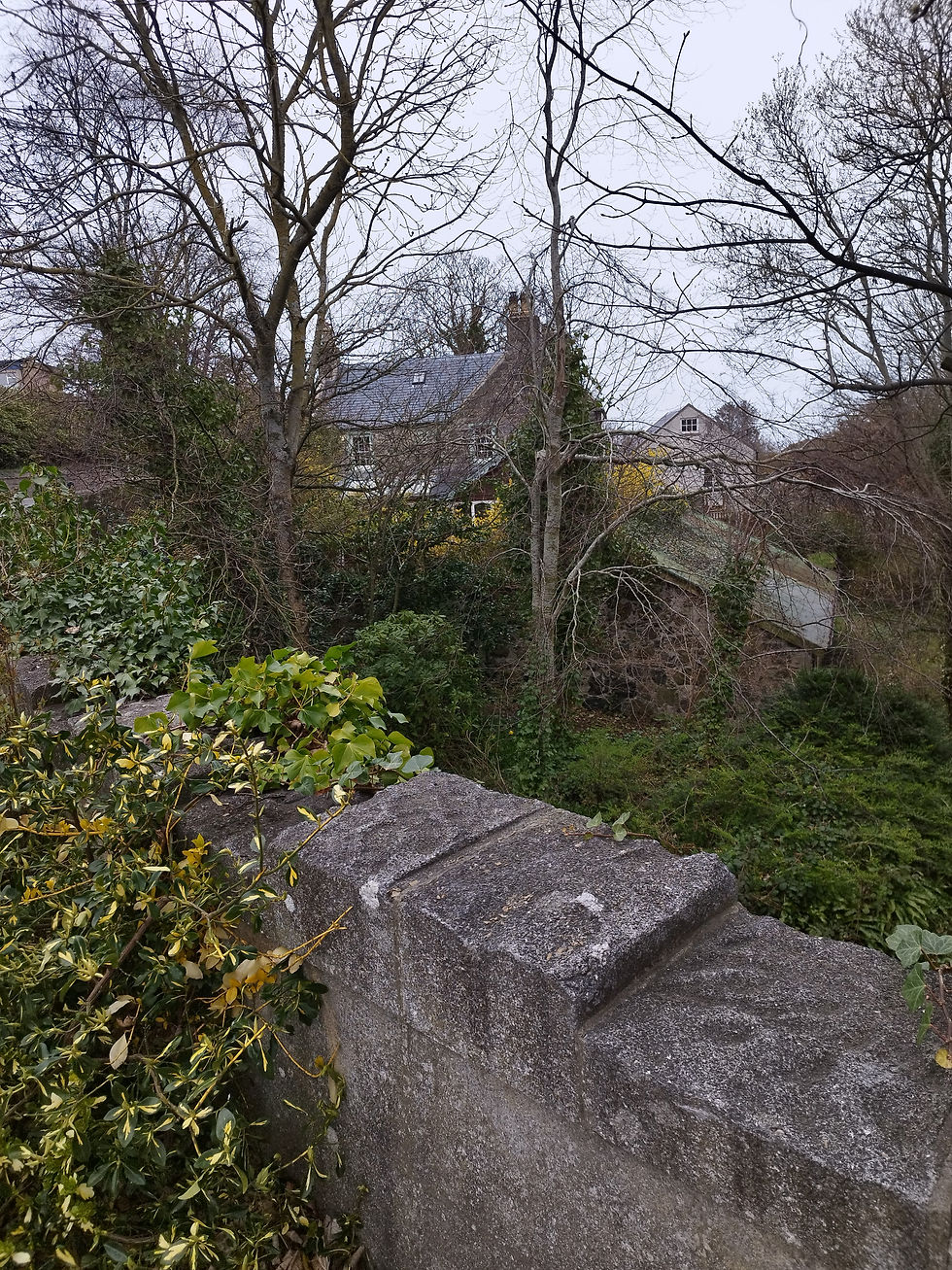
Burnside Villa
Burnside Villa was Dr Greig's home for many years. He died here in March, 1874.
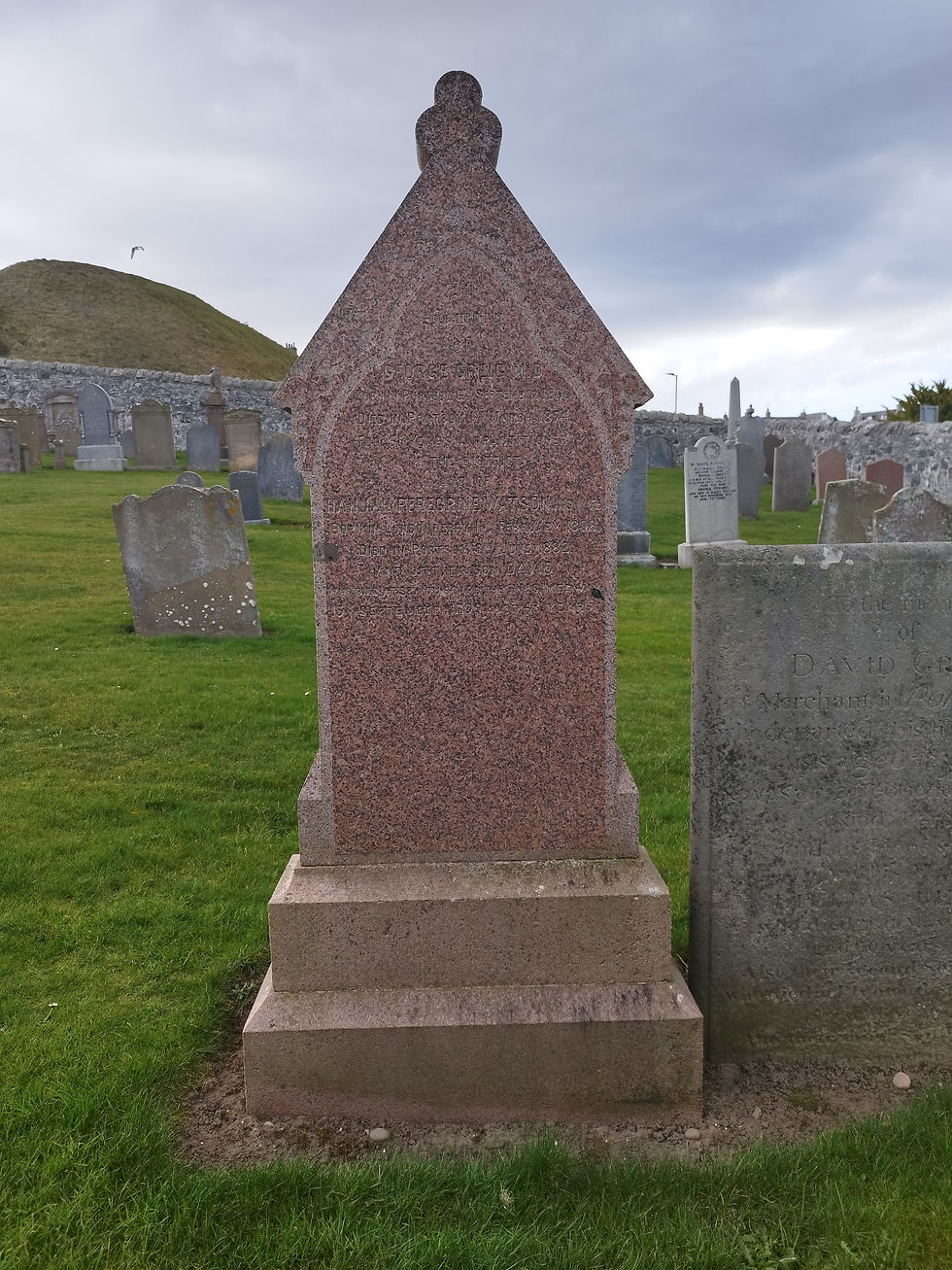
Headstone
The headstone commemorating Dr Greig, his wife and son can be found in the oldest part of Portsoy Cemetery.
Dr Greig's Manuscript,1843
TRADE AND COMMERCE
From the convenience of the Harbour it is reasonable to suppose that maritime trade formed the principal support of the town and on taking a retrospect of its history, we find this to be true. At one time within the last forty years, thirteen vessels belonged to the port and although their number is now (1843) reduced to eight, yet these are actively employed. The principal exports are grain, herrings, salmon, wood (for pit props), stones, lime, potatoes and occasionally cattle. Of these, the export of grain is by far the most considerable and has long formed the principal trade of the place, the extent of the agricultural district and the convenience of good roads having made this the shipping port of a wide range of country, comprehending even some parts of Aberdeenshire. Next in importance to this is herring.
This branch may be said to have commenced in 1812 on a very trifling scale indeed, being merely followed by a few fishermen. From that small beginning the whole of the herring trade of the town may be said to have taken its rise. It is true that several of the merchants were in it previously, but these had their fishing stations at Wick, Staxigo and Helmsdale. About 1817 it began seriously to occupy the attention of our townsmen and by 1820 the anxiety to engage in it may be said to have reached its height for from that time it began to decline and although it experienced a temporary revival in 1832, yet for nine years afterwards it was so unsuccessful that apprehensions were entertained it would be abandoned altogether. However, the last two seasons have proved so fortunate that it is to be hoped with the aid of the additional accommodation afforded by the improvements to the Old Harbour it may again recover. From twenty to thirty boats commonly fish here.
Several cargoes of wood of a particular size (commonly small young trees) are sent from here every season to the collieries on the coast of England and south of Scotland to serve as pit props. These mostly come from the interior of the country.
The lime is brought from the lime works of Boyne where there is an inexhaustible vein of limestone that has been successfully wrought for many years by Mr. Wilson of Brangan; and produces lime admirably adapted both for agricultural and building purposes. The annual produce of the quarry is about thirteen thousand barrels of lime. There is a quarry of beautiful quartz on the north side of the Hill of Durn from which exports are occasionally made for the potteries in England. It is considered to be peculiarly suitable for this purpose and to be much superior to the English quartz.
The stake net salmon fishing was commenced at a station near to the mouth of the Burn of Boyne about fifteen years ago (1828) by Messrs. Gerrie and Hector and since at various places along the coast and is now prosecuted with great success by the Messrs. Hogarth of Aberdeen, who have an establishment for the purpose in this town. The premises, which are situated in the Seatown, consist of a building of three storeys comprehending lofts for their apparatus, a boil house and an ice house. Abundant supplies of ice are obtained from the loch and mill pond. The average number of salmon caught for the last few years is 147 and of grilse 410. The rent to the proprietor for the part of the coast within the parish of Fordyce is £12.10/-. Messrs. Hogarth employ vessels of their own in collecting the salmon from the different fishing stations and carrying them to London whilst quantities are also sent weekly by the steamer to Leith.
The imports are coal, wood, grain for seed, bark, salt, iron, bones, stoneware and grocery goods.
The principal of these is coals. This is not only for the purpose of fuel for private consumption but also for the use of several gas and lime works in the interior of the country. As might be expected from the extent of the fishing, salt forms the next most considerable import, both of the great and finest kinds; most of the country dealers drawing their supplies of that article from this place. Wood, both for the purpose of house and shipbuilding and billets for herring barrel staves, is imported in great quantities.
Bark for the use of fishermen and the tan works of Huntly and Keith also constitutes a considerable article of import; and some country people earn a comfortable livelihood by driving it and coals to these towns. The manufacture of bone manure is carried on to some extent by Mr. Smith in an excellently constructed site of machinery situated near the meal mill of which he is tacksman.
The large water wheel not only gives motion to the bone machinery but also turns two circular saws and a threshing machine, all situated under the same roof. In working the bone machinery, however, it is assisted by a flywheel, perhaps the largest of the kind in the north, which moves on the outside of the building within the courtyard. In the Low Street some distance from the bone mill is the Burnside Distillery.
There are two bank agencies in the town viz.: - The North of Scotland, Mr. Moir; the Aberdeen, Mr. Murray. There are also four Insurance Agents viz.: - Mr. Minty, the Aberdeen; Mr. Murray, the North of Scotland; Mr. Forbes, the Caledonian; Mr. Moir, the Marine. A receiving branch of the Banff Central Savings Bank was established also in 1837.
Formerly the manufacturing of linen, cotton and woollen cloth was carried on to some extent, nearly thirty looms being employed in the different parts of the town; but that branch of manufacture having been gradually on the decline since the beginning of the present century is now almost entirely abandoned, there being only four looms in the town.
The manufacture of thread was also actively carried on, the works and bleachfield being situated in a hollow a little to the eastward of the town where there was a fine supply of water. This work was commenced by Messrs. Robertson, who erected the building and machinery and formed the bleachfield. After him it was carried on by the Messrs Gordon Knight & Co. and about 1805 it fell into the hands of Mr. Forbes Watson, who tried it for a few years when it was finally abandoned and the machinery sold. Part of the premises and grounds is now occupied by Mr. Peterkin as a rope and twine manufactory. The importation and dressing of flax was also pursued for many years by Mr. Knight and is carried on still but on a very limited scale by Mr. Cheyne.
The manufacture of salt was formerly on to a small extent, the works for which were situated on the west side of the harbour, near the Dounie; but after a long trial it turned out so unprofitable as to be abandoned more than thirty years ago.
The bold line of the coast in the vicinity of the town, indented by several creeks, afforded a ready access to the surrounding country, and rendered it singularly adapted to the purpose of contraband trade.
Accordingly, we find that during the greater part of the last century every merchant in the town and of various places in the neighbourhood became engaged in smuggling. The articles imported in this manner were all kinds of foreign wines and spirits, tea, tobacco, chinaware and various kinds of soft goods.
Several vessels, well manned and armed, were employed in the trafficking and many of the old houses display numerous secret nooks and corners for concealing smuggled goods. The most noted of the merchants engaged in it was Mr. Alexander Bremner, (better known as 'Laird Bremner) who lived in a large house near the Corfe House, which is still standing and occupied as grain lofts.
This individual, besides other branches of business, owned no fewer than eight vessels
wholly his property; also the house, now occupied as the 'Commercial Inn' with the adjoining feus and the houses surrounding that piece of ground in the lower Aird. He had besides, the estate of Bracken Hills about four miles from the town where he built a small mansion house and laid out an excellent garden, the remains of which are still to be seen. He also possessed the estate of Pitgaveney in Morayshire. He kept his carriage and it was long remarked that his daughter had the first umbrella to be seen in the streets of Portsoy
He also kept a lawyer in his house and gave him a handsome salary. He acted as a clerk and also managed the law processes in which he became involved, in consequence of his many infringements of the laws. His vessels generally delivered their cargoes at the small pier on the west side of the harbour (taken down in the recent improvements), which came to be called from thence 'Bremner's Pier', a name which it retained as long as it had existed.
His house is reported to have had many concealments in it, several of which are said still to remain undiscovered, although most of them were found when the partitions were taken down; and certainly from the extent of the premises, it must have afforded vast accommodation for any purpose of the kind. An extensive concern such as this could not eventually be carried on with success. He became involved in tedious and expensive lawsuits and most of his ships were lost or captured by revenue officers. He was finally reduced to bankruptcy and died in prison.
The next merchants of consequence were the Messrs. Robertson, already mentioned, who were also deeply engaged in smuggling. They were the owners of several vessels and at their own expense fitted out a privateer, the Neptune, of eight guns to emise against the French and the Spaniards. This vessel was commanded by Captain Elder and took several prizes although she turned out a losing speculation to her owners. It has been said indeed that at this period the Harbour could not have contained all the ships belonging to the place had they been in it at one time. They also failed, and Mr. Robertson junior, better known by the name of Mister Sandy, a man of great commercial talent but of profligate character, died in the Abbey of Holyrood Sanctuary, not it is said without suspicion of having come to his death by unfair means. The houses on the south side of the Square belonging to Mr. Macdonald were built (or very much altered) by the last named gentleman.
Notwithstanding the severe shocks given to the trade of the town by these failures it still continued to flourish and the smuggling was prosecuted with unremitting vigour. The Board of Excise at length established a guard boat here under the orders of Mr. Cooke, while one of the cutters, the "Royal Charlotte", Captain Aird, constantly cruised in the Firth. This latter individual by his daring activity in the service and his invariable success when any of the smuggling craft risked an engagement (which from the complete state of their equipment they seldom hesitated) became eventually the end of these adventurers. This induced them to employ small vessels having a light draught of water in the keel and better adapted for sailing than carrying heavy cargoes. One of the most noted of these both for her sailing and working capabilities as well as the admirable seamanship which characterised her crew was a small sloop named the "Bush of the Garden", but more commonly known as the "Bussey". Of all the smugglers she was the most successful, never failing to land her cargo and be off to sea before the cutter or guard boat could approach.
One morning she came into the bay and Mr. Cooke, knowing that she had returned from Holland and judging her to be heavily laden and that she would prove an easy prize, manned his boat and attempted to board her. However, he found himself mistaken as her crew stood to their arms and a sharp action with musketry took place.
But although within pistol shot, he never could get near enough to attempt boarding. At length, after a good deal of firing on both sides, the "Royal Charlotte" hove in sight and the "Bussey" sheered off and made her escape. Several of Mr. Cooke's men were wounded, but none severely, although it is said if the fight had continued much longer he would have been beaten off or sunk. Upon another occasion, Mr. Cooke wanted to examine a vessel in the harbour respecting which he had suspicions, but the crew made a most determined resistance and a scuffle ensued in which the mate (Mr. Watson) had the fingers of one hand nearly severed by the blow of a cutlass. Mr. Cooke effected his purpose but found nothing to justify his suspicion.
A considerable time after the above-mentioned engagement, the "Bussey" while lying in Banff Bay for the Master who had gone onshore on some business, was pounced upon and captured by Captain Aird after a smart action in which the mate, William Gray, who commanded, was killed at the helm before the vessel surrendered and the unfortunate "Bussey" was carried off in triumph. The late Mr. William Park was for many years shore master here and was cabin boy on board the "Bussey" at the time of her capture. He was standing close by the mate when he fell.
Losses of this kind saw the establishment by the Excise of an active riding officer in the town - Mr. Alexander Geddes, afterwards superior of Excise at Elgin - who traversed the country armed to the teeth and being a man of resolute and determined character whom none of the smugglers cared to encounter with, the contraband trade gradually gave place to a better system. Traces of it, however, still lingered for some years, although only one vessel, which belonged to Banff, was employed in it. This sloop, which might fairly be termed the last of the smugglers, after having made several successful trips, was fitted out for another and lay off the town intending to sail the following day. But during the night a dreadful storm arose which compelled her to cut her cable and run the bar at low water. The moment she grounded, the above mentioned officer along with another from Cullen boarded and clapped the broad arrow on her. The crew made no resistance but endeavoured with axes and crowbars to render the vessel a complete wreck in which they effected their purpose as she was sold and broken up soon afterwards. No vessel from that time belonging to the town was engaged in smuggling.
During the time of the smuggling, the manufacture of tobacco and snuff was carried on in a building situated in the low street near the distillery, and is still distinguished by its high pointed roof. With the decline of smuggling this branch of trade failed also. It was afterwards tried on a smaller scale in the Old Cullen Road but with no better success. In 1827 the accommodation afforded by the New Harbour induced some spirited individuals to attempt the formation of a "Portsoy and London Shipping Company". Two vessels were built of 70 tons each but after a trial of several years this laudable design eventually failed.
PORTSOY: HISTORY AND TOPOGRAPHY
The town of Portsoy is situated on the shores of the Moray Firth, which here forms a deep bay or roadstead affording excellent anchorage. The coast is bold and rocky especially on the west side of the bay, indented in several places by small creeks. At each extremity of the bay, the rocks project some distance into the sea; forming two promontories, termed the Eastward and Westward Heads. Nearly in the centre of the bend formed by the shores of this bay the town is situated. The ground on which it stands is very irregular and is traversed by the Soy, a small rivulet which intersects the town. This stream which rises from the hills to the South and West of the town, is joined when near it by a branch of a neighbouring stream, the Burn of Durn, and their united waters form a small lake on the Southward of the town, termed the Loch of Portsoy, which supplies water sufficient to turn several mills, and finally empties itself into the Moray Firth near the old Harbour.
Near its mouth the rocks, which extend into the sea are some distance apart and form a creek, which requires very little assistance from art to form a safe Harbour. The situation of this Harbour, so near the mouth of the Soy, has doubtless given origin to the name of the town, hence Portsoy.
There is little question but the safety and convenience of the creek which afterwards became the Harbour may have induced some seafaring people to build their habitation near it which first gave rise to the town. The origin of it, however, is involved in obscurity. It had increased so much by the middle of the sixteenth century that it was created a Burgh of Barony by Queen Mary in 1550. In speaking of 'by Queen Mary' it would mean during the reign of this unfortunate Sovereign, who was born in 1542 was then in her minority, so that the creation must have taken place while the reign of Government was in the hands of her mother, the Queen Regent, Mary of Guise.
Four years subsequently (1554) it received a Charter creating it a Royal Burgh of Barony with the power to elect a Magistracy and impose Burghal Taxes but to have no vote in the election of a Member of Parliament. The Charter never having been acted upon fell into abeyance and has become a Dead Letter. The original, or a copy of it, is said to be still preserved among the County Records in the Sheriff Clerk's Office in Banff.
The Baron Baillie is usually the Landlord or Factor and that office has for many years been held by Alexander Rainey, Factor of Boyne.
The present population is upwards of 1500.
No date would seem to exist as to the time the old Harbour was built, upon which the existence of the town so much depended, but from the rudeness of some parts of the structure its erection must have taken place at a very remote period. It forms a very safe and commodious though small basin and in the season 1843 underwent considerable repairs. The North pier which was so much shattered by the storms of the previous winter as to endanger its stability was thoroughly surveyed. About thirty feet of it was taken down and rebuilt from the foundation; the South and West sides which were in a ruinous condition were wholly taken down and rebuilt with hewn stone from Dunnideich Quarry and it formed as neat and commodious small harbour as is to be found in the Firth.
In 1825 the noble proprietor the Earl of Seafield at his sole expense, anxious to do his utmost to promote the prosperity of the town commenced a new harbour a little to the North East of the present one. It was finished in little more than three years and formed one of the safest harbours on the coast and could be entered by vessels at a period of the tide when they durst not have attempted to reach the Old Harbour.
The principal part of the materials were provided from the Quarry of Boggierow about a mile from the town. Some of these stones are of a great size and weight and admirably adapted for the purpose. The pitching and pauls were from the granite Quarry of Cairns in the Parish of Banff. This granite is of a white colour and uncommonly durable texture and the workmanship was of a very superior description, but whether the plan of it was faulty or not, it was not proved 'seaworthy' for it was severely shifted by a storm accompanied by a very heavy swell from the North-east on the 7th. January 1839 when several large stones were forced out from the north end of the breakwater and it became evident that were another storm to ensue, the destruction of the whole harbour was inevitable. These fears were unhappily realised for on the 30th. January of the same year a tremendous storm accompanied with a heavy sea and uncommonly high tide demolished more than half of the building and rendered the harbour, which was of so much consequence to the town, a mass of shapeless ruins. This inflicted a severe blow on the trade of the place which depended so much on maritime intercourse but it was hoped that the repairs and improvements made upon the Old Harbour would in some degree remove and hopefully the period was not too far distant when the New Harbour would rise again from its ruins and restore the commercial prosperity.
There are several well-built old houses around the Old Harbour and on the west side is situated a large granary belonging to the Earl of Seafield and used for storing up that part of his rents which are paid in kind. It is commonly denominated the 'Corfe House' and is a long narrow building of four storeys, the three upper being used as a granary while the lower is divided into several vaults most of which are appropriated for warehousing goods landed from vessels in the harbour and one is set apart as a lock-up house.
Near the north side of this building is one of the small conical eminences which are to be found in many parts of Scotland. It is known by the name of "Downie" and it is believed by some to be of Druidical origin but it is evidently one of those eminences denominated 'boat on hole Hills' used anciently as places of meeting for the dispensation of justice. Another of these hills of the same shape is to be found in the Parish of Deskford and called the 'Fairy Hillock of Ardoch'.
On the east side of the Old Harbour is a very old building said to have been formerly occupied by the family of Ogilvie of Boyne as a town residence. The accommodation within is sufficiently ample but not of a description to be used by the family of any modern landed proprietor.
It is known by the name of the ''Lodging'. On the freestone lintel over the entry door there are carved in relief the letters A B E C with a heart in the centre and date 1696. At each corner of the south gable is a block of freestone carved into a representation of the human head rudely executed. The letters above the door are probably not the initials of the name of the original proprietor and his wife but by whoever it may have been erected. There is little doubt but it was at one time occupied by the Boyne family and will appear in the sequel.
Within the period in which it was built almost every landed proprietor had a residence in the town or village near his estate. As for instance in the town of Maybole in Ayrshire, the principal houses of which were almost entirely the property of the surrounding gentry who occupied them as winter residences when they could enjoy the society of each other without the risk of travelling at a time when good roads were unknown in Scotland. Even in our own country there were a good many houses known by the names of the neighbouring landed proprietors who invariably resided in them during the winter.
Besides, the Ogilvies of Boyne, were the superiors of the town, which would naturally lead them to desire a winter residence there and which would bring them into closer neighbourhood with the family of Dunbar of Durn.
The superiority continued in the Boyne family until 1745 when they unfortunately engaged in the Rebellion and their estates were forfeited to the Crown. It was afterwards given to the Earl of Findlater and Seafield in whose hands it has remained ever since. A daughter of the same Earl married Sir Ludovic Grant of Grant to whose grandson, Sir Ludovic Alexander Grant, the title of Earl of Seafield descended on the death of the last Earl of Findlater in 1811 at Dresden. An aged relation who died about thirty years ago informed the writer that he perfectly remembered accompanying his uncle to see Lady Ogilvie Boyne carried out of the Castle which she had absolutely refused to quit when taken possession of by agents of Government after the suppression of the Rebellion. He stated that her Ladyship occupied the small vaulted chamber in the North West corner of the second storey of the Castle and still known as the Lady of Boyne's closet, in fact it is the only room in it that is in the least degree entire. Out of this she was carried in an armchair by two men to the green before the Castle and when there was lifted upon a horse behind a man and taken to the 'Lodging' in Portsoy. What became of her afterwards he never could learn. (The above is given in the words of the venerable informant who at the time of the occurrence was about seventeen years of age).
In all probability the Government may have granted Lady Ogilvie a temporary asylum in the 'Lodging' until she could be otherwise provided for.
About midway between the Harbour and the upper part of the town is the Square, a wide open space where streets intersect each other and in which are some of the best houses in the town. The North West side of it was long disfigured by a row of small mud walled ruinous houses which formed a most disagreeable contrast with the other buildings and completely hid some excellent houses to the rear of them. Fortunately in 1832 these became the property of the late Mr. William Minty, a most worthy and public spirited individual who removed the old houses and erected a neat cottage. Soon afterwards he purchased the adjoining property belonging to St. Stephen's Mason Lodge and the whole underwent a complete repair which has very much improved the appearance of that side of the Square. His design has been fully carried out and completed by his son Mr. A.L. Minty the present proprietor.
The town contains about twenty streets besides several lanes and closes. The greater part of it, however, is of modern erection, the writer having conversed with many old people who perfectly remembered the Culbert Rig being under crop. Its designation was derived from a person so named who farmed it and who lived in a small house near where Mr. Grant's coal yard is situated. He also rented a good part of the ground along the Burnside to the south of the Rig. The writer also remembers when most parts of the New Aird and the Roseacre which are now almost covered with streets and houses being subjected to tillage and forming part of the Hill Croft before the turnpike road from Banff was made through it.
The Seatown has also been much improved and extended of late years. Formerly it consisted of little more than a few huts huddled together without any attention to order and which was scarcely habitable. Within these last few years, however, several substantial houses have been built and a new street laid off at the eastward of the old Seatown. It is regretted that too much of the old plan is still adhered to of the building with the gable towards the street.
In regard to places of public worship, a decided and most gratifying improvement has taken place. About thirty years ago, the buildings occupied as such scarcely bore any indication of the sacred purpose for which they were appropriated as will be more fully noticed when we come to consider the ecclesiastical state of the town. ted 1836.
During the incumbency of Mr. Grant and chiefly by his exertions, the new Chapel was erected to which Mr. Macnaughton has lately added a neat parsonage house besides greatly improving the approach to it from Burnside Bridge and planting a garden and shrubbery.
ECCLESIASTICAL STATE
Until 1741 the inhabitants of Portsoy belonging to the Established Church attended public worship at the Parish Church of Fordyce, there being no place of worship of any description in the town.
This was felt to be a serious inconvenience especially in winter, the distance being two miles and the roads far from good. Accordingly in the above year 1741 it was made a preaching station, the Committee for distributing the Royal Bounty nominating the Clergyman and paying him £20 per annum of stipend. The Earl of Findlater, however, offered to relieve the Committee of the burden of the stipend providing he was allowed to nominate the incumbent. In this they agreed and the patronage has ever since remained in the family. The first Presbyterian place of worship in the town therefore was opened in the above year. It was situated in the back street nearly opposite to the Burnside distillery. Soon afterwards, however, in 1746 a new church was erected at the top of the Church Road on the site of the present Society's School which was a very neat building with galleries, the access to which was by stairs on the outside and surmounted by a belfry on the west gable. The bell was cast on purpose in Holland as by the following inscription 'For the Presbyterian Church of Portsoy, John Spicht Rotterdam fecit 1746'. The bell is still used by the Society's school.
The walls of this Church being constructed with clay in little more than half a century had become insufficient and the increasing number of hearers rendered more ample accommodation necessary. Accordingly in 1804 it was finally abandoned
A large barn-looking edifice situated in Skulhendry Street that had been erected by a congregation of dissenters, was then hired for the Established Church, but besides being inconveniently small, this house was altogether most uncomfortable. The walls were destitute of plaster and being concealed the wretched state of the roof proved no protection from the fury of the elements.
In short, the miserable state of the Portsoy Kirk became quite proverbial while from its having a tiled roof and the street it stood in, received the name of the "Red Kirk of Skulhendry ".
To these inconveniences the people submitted for twelve years but a better order of things soon took place. By the unwearied exertion of the incumbent, the Rev. Daniel Cruickshank, the funds for the erection of the present church were raised and the foundation laid in summer, 1815. It was opened for public worship by Mr. Cruickshank in the following year. The contractors were: - mason work, Mr. William Ritchie; carpenter work, Mr. Selam Wilson; slater work, Mr. George Scott; plaster work, Mr. William Stephen. It is a neat but plain edifice calculated to accommodate 700 sitters and has a belfry on the west end but still labours under the inconvenience of being unenclosed and the ground about is a thoroughfare to the public. It is beautifully lighted with gas for the evening service during the winter and has long been remarkable for the excellence of its choir. It is also chiefly indebted to Mr. Cruickshank, who spared no pains in procuring good teachers to instruct the young members of his congregation in psalmody and his successors have also followed his example.
The stipend is paid by seat rents and an annual allowance of £40 from the Earl of Seafield. The payment of seat rents, however, even though they be comparatively low, is felt to bear heavily on the labouring classes.
The following is a list of the Presbyterian ministers of this time since its first erection into a preaching station in 1741: -
Mr. Robert Yule, removed to Kirkwall.
Mr. James Ogilvie, removed to Ordiquhill.
Mr. Thomas Mitchell.
Mr. Robert Ogilvie, removed to Ordiquhill.
Mr. Burnet, removed to Footdee, Aberdeen.
Mr. Thomas Steel, removed to Dort in Holland.
Mr. Walter Chalmers, removed to Deskford.
Mr. Abercromby, removed to Banff.
Mr. James Kelly, removed to Leochel Cushnie.
Mr. William Grant, removed to Inveraven.
Mr. Daniel Cruickshank. Died Nov. 1828
- the first Minister to die in charge
Mr. Alexander Reid. Joined the Free Church in June 1843.
Mr. Peter Murray, admitted Jany. 25 1844.
An aged individual who is still living (Mr. G. Anderson, aged 92) informed the writer that Mr. Murray is the tenth Established Minister he remembers to have seen in Portsoy, Mr. Robert Ogilvie being the first.
Towards the end of the last century a small congregation of Roman Catholics assembled here and had their place of worship on the Braehead at the west-end of that house occupied by Mr. James Ross and certainly their numbers must have been few to find accommodation in such a small building. Afterwards when they became more numerous, they purchased and fitted up as a chapel, that house in the Low Street which is now Burnside Distillery. In 1829 the present Chapel was built. It is a neat and commodious building calculated to contain 250 sitters. It has four minarets on the south gable, the apex of which is surmounted by a cross. It stands on a high bank above the loch and overlooks the approach to the town from the south and east. The entrance is in the south gable and on the left hand side of the vestibule is the vestry and on the right the staircase to the organ gallery. This gallery is at the south end and contains an excellent organ presented to the Banff congregation by the Earl of Fife and by them allowed to be transferred here. The altar is at the north end, and on the side of it stands the pulpit. On the communion table is placed a handsome tabernacle and on the wall above it are the names of the Roman Catholic clergymen who have had charge of this congregation. viz.: -
Mr. William Reid, removed to Keith.
Mr. James MacLaughlan, removed to Huntly
Mr. John Forbes, removed to Elgin.
Mr. Alexander Grant, died February 1833.
Mr. William A. Stuart, removed to Preshome.
Mr. George Augustine Griffin, appointed 1836.
During the incumbency of Mr. Grant and chiefly by his exertions, the new Chapel was erected to which Mr. Macnaughton has lately added a neat parsonage house besides greatly improving the approach to it from Burnside Bridge and planting a garden and shrubbery.
THE HERITAGE ARCHIVE
A digital home for the voices, records, and memories of our historic coastal town.
The History of Portsoy
Click the section below.
Your Memories Matter
The Heritage Archive is a living history made possible by you. If you have photographs, personal stories, or historical documents related to Portsoy, we would be honored to include them. Please use the form below to share your contributions with the community.
Questions about our history?
We hope to expand our service to answering your questions about local heritage or history. Please check back regularly!