THE HERITAGE ARCHIVE
A digital home for the voices, records, and memories of our historic coastal town.
The History of Portsoy
Ancient History
Based on Research by Findlay Pirie
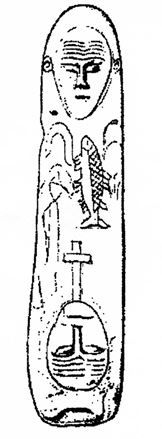
There is considerable evidence of Pictish presence in the north-east of Scotland with the number of symbol stones which have been discovered. The Pictish fort at Burghead in Morayshire has been well researched. Other, smaller defensive sites were built at different times all along the Moray Firth coast, and Portsoy’s Doonie is one example. We have no firm evidence that the Doonie was specifically a Pictish fort, however the very name, from the Gaelic dùn (a fortified place) indicates it was used for defensive purposes at some point in history. Moreover, in the British Museum, though not on display, is a pebble with a variety of incised Pictish designs, which is believed to have been found at Portsoy by a Dr J. D. Crowden. Its exact findspot is unknown, but it reflects Pictish presence at Portsoy, and presumably their use of the natural harbour.
The pebble is often referred to as the Portsoy Whetstone. It is described by Charles Thomas in the Archaeological Journal 1963 thus:
“A remarkable pebble 5⅝ inches long, with a variety of incised designs...The principal face has two human heads seen frontally, one at either end, chins to centre. The first head is oval with ring ears, five brow lines and pointed chin. Next to it is a fish symbol, the upper part cross-hatched, between four other symbols; plain crescent, two horse-shoe symbols, and another for which cf.ECMS 99.99a. From the chin of the other head, a motif like an uneven Latin cross depends. Reverse, another fish.”
Archaeologist Anna Ritchie, writing to Findlay Pirie in 1995, mentioned that the pebble is sometimes called the Portsoy Whetstone, not because it was really used to sharpen blades, but because it was thought perhaps to be a ceremonial whetstone, like a larger example found in the Sutton Hoo ship-burial in East Anglia.
The Proceedings of the Society of Antiquaries, 1974-5 mentions a bronze Pictish pin found at Golspie, Sutherland in June 1974. Like the Portsoy Whetstone, the pin features a man’s face. While the face motif is unusual in Pictish art, its appearance on the Portsoy Whetstone is not unique.
The Picts (c.300 - 900 AD)

The Early Iron Age (c.800 - 400 BC)
Durn Hill Fort
Prominent above Portsoy is the Durn Hill (199m). It offers a rewarding, and not too challenging walk for locals and visitors alike. The summit affords breathtaking views of Portsoy and the surrounding district. But the Durn Hill also provides us with evidence of a very early human settlement of the area. An article in the Banffshire Journal in August 1942 stated, “It commands a good view of the country and probably was used as a retreat for the people, their families and cattle in the event of invasion from the sea by the Danes, or incursions from the wild Highlanders.” Subsequent study tells us that the earthworks were there long before the Danish invasions.
Historic Environment Scotland informs us that three lines of earthworks can be traced on the hill today. When built, these would have been reinforced by “substantial” palisades, with timber stakes driven into long, wide trenches. There is evidence too of an “elaborate” entrance point. The purpose of this fortification would have been twofold; to provide a place of safety for the community in case of attack, and as a demonstration of the power and influence of the people who lived there to any who passed by – a “statement of presence and power”. The HES report concludes, “The monument retains structural and other physical attributes which makes a significant contribution to our understanding of the past.”
Neolithic Period (c.4000 - 2500 BC)
Glassaugh Chambered Cairn
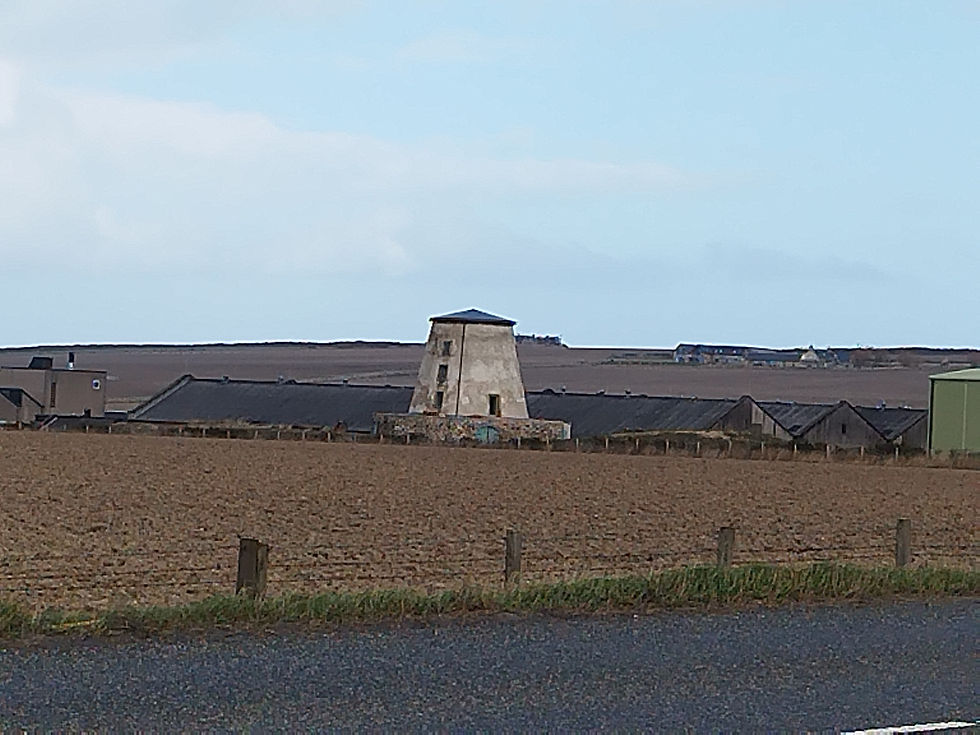
In the 18th century, General James Abercrombie of Glassaugh built the well known local landmark, the "Cup and Saucer". For many years, this distinctive building lay derelict, its tapered stone conical top resting on a wider base, reminiscent of a cup placed upon a saucer. Its original purpose was a windmill. Atop the "cup" would have been a timber tower, on which the sails would have been mounted. The building was restored in recent times as a private residence.
The windmill must have been a wonder of its time. The General sadly had little regard for ancient history, for the stone used to construct the windmill was obtained from the demolition of an even greater wonder, a Neolithic chambered cairn on the same site, the cairn surrounded by a circle of standing stones, said to be fourteen feet in height, with a diameter of sixty feet. The stones were removed around 1760. The height of the Glassaugh standing stones would have put the site on a par with Callanish in Lewis, or Avebury in Wiltshire.
The Banffshire Journal reported in 1942, "Some sixty years ago another discovery was made a little to the west of the Hill of Durn, in the Glassaugh area. Here there was a hillock of some size, in all probability looked upon as a natural elevation of the ground. Chance led to inspection and this revealed a structure of stone covered with a coating of green sods. The interior, which was of large size, disclosed a stone coffin, containing a human skeleton. The inside measurements of the building were sixteen feet in height and sixty feet in diameter."